
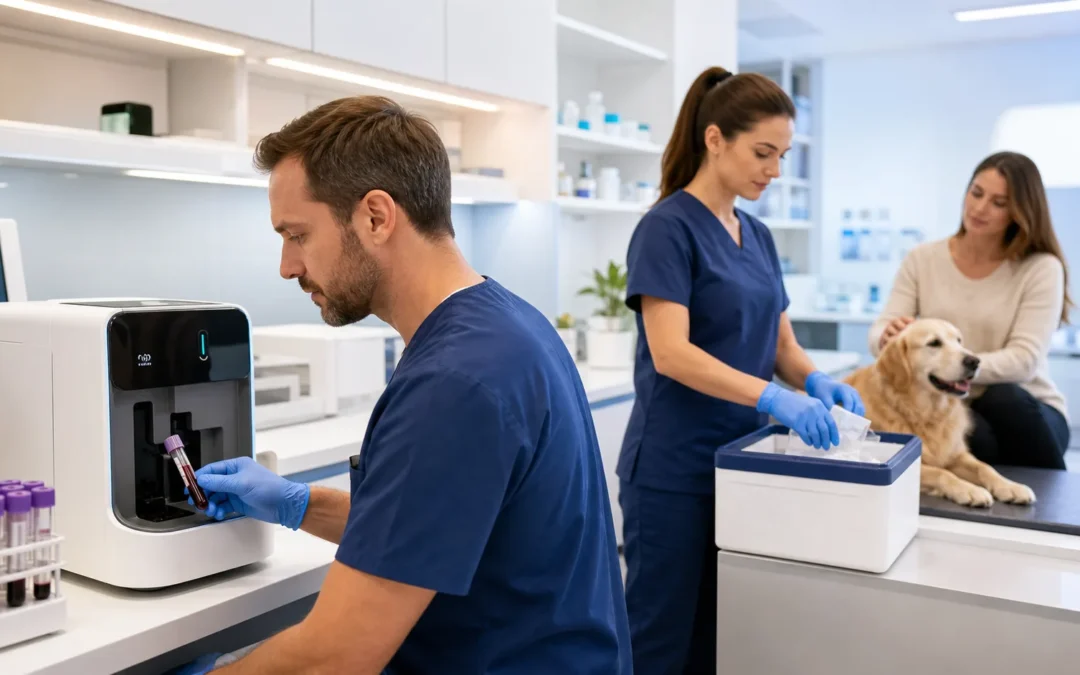
In-House Lab Results Vs. Send-Out Tests: When Speed Matters
Diagnostic testing can help veterinarians gather important information about your pet’s health and determine which next steps may be appropriate.
Fast Answers Can Guide Your Pet’s Care
Pets cannot explain where they hurt or why they suddenly feel different. When your pet is vomiting, sleeping more than usual, drinking extra water, or acting unlike themselves, diagnostic testing can help us look beneath the surface and better understand what may be going on.
Lab testing is one part of the full picture. During an exam, we also consider your pet’s medical history, current medications, lifestyle, physical findings, and, when needed, imaging or ongoing monitoring. Results can give us helpful information sooner, but they always need to be interpreted alongside your pet’s individual needs.
Some tests are processed right here at the clinic, while others are sent to an outside reference laboratory. Both choices have an important role in veterinary care. In-house tests can provide information quickly, while send-out tests can offer more detailed or specialized answers when a case calls for deeper investigation.
In-House Testing Supports Timely Treatment
An in-house veterinary laboratory in Lutz allows us to process certain samples during or shortly after your pet’s visit, depending on the test. That can be especially helpful when a pet is sick, injured, or experiencing sudden changes that need timely attention.
Common in-house testing may include:
- Blood chemistry panels
- Complete blood counts
- Electrolyte checks
- Urinalysis and fecal testing
- Screening for certain parasites or infectious diseases
These tests can help us assess areas such as hydration, blood sugar, kidney and liver values, red and white blood cell levels, and possible signs of inflammation or infection. None of these results tells the whole story by itself, but together they can help us decide what should happen next.
Prompt testing may be useful when a pet has repeated vomiting, weakness, urinary concerns, possible toxin exposure, or signs of heat-related illness. For example, bloodwork and urine testing may help us evaluate hydration and electrolyte balance in a pet that has been unwell during a hot Florida day. Based on the findings, we can discuss whether supportive care, additional diagnostics, monitoring, or referral is appropriate.
Send-Out Tests Can Deliver More Detail
Send-out testing is not simply a slower version of in-house testing. In many situations, it is the best way to get information that cannot be evaluated in our clinic laboratory. Reference laboratories have broader testing options and may involve advanced equipment or interpretation by veterinary specialists.
Samples may be sent out for testing such as:
- Biopsy and pathology evaluations
- Bacterial cultures and antibiotic sensitivity testing
- Hormone and allergy testing
- Specialized infectious disease panels
- Genetic screening or advanced blood and urine analysis
These tests often take longer because the sample must be transported and processed through a more detailed laboratory workflow. Waiting can feel difficult when you are concerned about your pet, but thorough testing can be very meaningful when the answer is not clear right away.
We may recommend send-out testing for ongoing symptoms, an unusual mass, a difficult-to-diagnose concern, or a chronic condition that needs closer monitoring. In some cases, we begin with in-house lab results to learn more quickly about your pet’s condition, then follow with specialized testing to confirm a diagnosis or help identify the most appropriate treatment approach.
Late Summer Symptoms May Need Prompt Attention
August in Lutz often means plenty of heat, humidity, rain, and outdoor activity. Those conditions can make it easier for pets to become dehydrated or overheated, and standing water and outdoor exposure may increase contact with parasites, bacteria, and other health hazards.
Not every change in behavior means there is a serious problem. Still, it is wise to seek professional guidance when your pet seems unwell or their symptoms are not improving. Signs worth discussing with us include:
- Excessive panting, weakness, or unusual tiredness
- Vomiting, diarrhea, or refusal to eat
- Frequent urination or straining to urinate
- Pale gums, coughing, or breathing concerns
- Sudden changes in behavior, thirst, or appetite
Fast diagnostic information can be especially helpful during summer illnesses. Bloodwork and urine testing may help us look at hydration, organ function, electrolyte levels, and possible signs of infection or inflammation. Young pets, senior pets, pets with chronic conditions, and flat-faced breeds may be more sensitive to heat and deserve prompt evaluation when they do not seem like themselves.
Matching Testing to Your Pet’s Needs
The right testing plan depends on what we find during your pet’s exam and what you have noticed at home. Age, symptoms, medications, medical history, diet, activity level, and recent exposures can all shape our recommendations. When immediate information could guide care decisions, we may start with in-house testing. If we need more specific answers, we can recommend send-out laboratory work, X-rays, ultrasound, or other diagnostics as appropriate.
Your observations matter more than you may realize. Let us know about recent travel, diet changes, contact with other animals, swimming or outdoor activity, possible toxin exposure, changes in water intake, and when symptoms first appeared. Even small details can help us choose the tests that are most likely to be useful.
Both in-house and send-out testing are valuable tools, not competing options. Fast results can help guide timely decisions, while specialized testing can provide the added detail needed for a more complete understanding of your pet’s health. When concerning changes appear, especially during Florida’s hot and humid late-summer months, timely veterinary evaluation can help ensure your pet receives careful, individualized attention.
Clear Answers for Your Pet’s Care
At Van Dyke Animal Clinic, our team can help you understand which tests may best support your pet’s needs. Learn how our in-house veterinary laboratory in Lutz supports efficient, informed care during your pet’s visit. If you have questions or would like to schedule an appointment, contact us today.